


Page 18 - Bullion World Issue 11 Volume 05 November 2025
P. 18
Bullion World | Volume 5 | Issue 11 | November 2025
           Why Substitution Isn’t That Simple:


           Why Silver is Often Irreplaceable in


           Industrial Applications


           Introduction
           Silver holds a unique place in the industrial metals world. While its status as a precious metal
           often draws attention, many of silver’s demanding industrial and technological uses rely on
           properties that are difficult to match by other materials. As industries push to reduce costs or
           find substitutes (especially given rising silver prices and supply constraints), they invariably
           run into trade offs: performance, durability, reliability, cost, and scale. This article examines
           what makes silver so hard to replace, where substitution is most actively pursued, why many
           alternatives fall short, and what the realistic outlook is.


           The Properties That Make Silver Hard to Replace
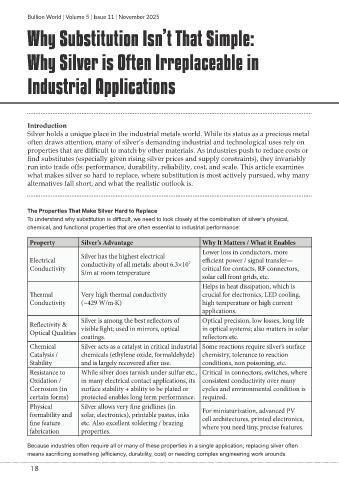
           To understand why substitution is difficult, we need to look closely at the combination of silver’s physical,
           chemical, and functional properties that are often essential to industrial performance:

           Property           Silver’s Advantage                        Why It Matters / What it Enables
                                                                        Lower loss in conductors, more
                              Silver has the highest electrical
           Electrical                                                   efficient power / signal transfer—
           Conductivity       conductivity of all metals: about 6.3×10⁷   critical for contacts, RF connectors,
                              S/m at room temperature
                                                                        solar cell front grids, etc.
                                                                        Helps in heat dissipation, which is
           Thermal            Very high thermal conductivity            crucial for electronics, LED cooling,
           Conductivity       (~429 W/m·K)                              high temperature or high current
                                                                        applications.
                              Silver is among the best reflectors of    Optical precision, low losses, long life
           Reflectivity &     visible light; used in mirrors, optical   in optical systems; also matters in solar
           Optical Qualities
                              coatings.                                 reflectors etc.
           Chemical           Silver acts as a catalyst in critical industrial  Some reactions require silver’s surface
           Catalysis /        chemicals (ethylene oxide, formaldehyde)  chemistry, tolerance to reaction
           Stability          and is largely recovered after use.       conditions, non poisoning, etc.

           Resistance to      While silver does tarnish under sulfur etc.,  Critical in connectors, switches, where
           Oxidation /        in many electrical contact applications, its  consistent conductivity over many
           Corrosion (in      surface stability + ability to be plated or   cycles and environmental condition is
           certain forms)     protected enables long term performance.  required.
           Physical           Silver allows very fine gridlines (in     For miniaturization, advanced PV
           formability and    solar, electronics), printable pastes, inks
           fine feature       etc. Also excellent soldering / brazing   cell architectures, printed electronics,
                                                                        where you need tiny, precise features.
           fabrication        properties.

           Because industries often require all or many of these properties in a single application, replacing silver often
           means sacrificing something (efficiency, durability, cost) or needing complex engineering work arounds.

            18

