


Page 19 - Bullion World Issue 11 Volume 05 November 2025
P. 19
Bullion World | Volume 5 | Issue 11 | November 2025

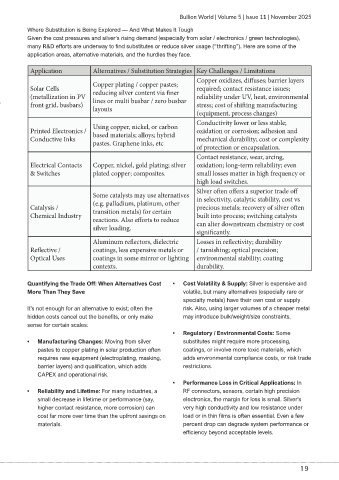
           Where Substitution is Being Explored — And What Makes It Tough
           Given the cost pressures and silver’s rising demand (especially from solar / electronics / green technologies),
           many R&D efforts are underway to find substitutes or reduce silver usage (“thrifting”). Here are some of the
           application areas, alternative materials, and the hurdles they face.

            Application           Alternatives / Substitution Strategies Key Challenges / Limitations

                                                                      Copper oxidizes, diffuses; barrier layers
                                  Copper plating / copper pastes;
            Solar Cells           reducing silver content via finer   required; contact resistance issues;
            (metallization in PV   lines or multi busbar / zero busbar   reliability under UV, heat, environmental
            front grid, busbars)                                      stress; cost of shifting manufacturing
                                  layouts
                                                                      (equipment, process changes)
                                                                      Conductivity lower or less stable;
                                  Using copper, nickel, or carbon
            Printed Electronics /   based materials; alloys; hybrid   oxidation or corrosion; adhesion and
            Conductive Inks                                           mechanical durability; cost or complexity
                                  pastes. Graphene inks, etc
                                                                      of protection or encapsulation.
                                                                      Contact resistance, wear, arcing,
            Electrical Contacts   Copper, nickel, gold plating; silver   oxidation; long‐term reliability; even
            & Switches            plated copper; composites.          small losses matter in high frequency or
                                                                      high load switches.
                                                                      Silver often offers a superior trade off
                                  Some catalysts may use alternatives   in selectivity, catalytic stability, cost vs
                                  (e.g. palladium, platinum, other
            Catalysis /           transition metals) for certain      precious metals; recovery of silver often
            Chemical Industry                                         built into process; switching catalysts
                                  reactions. Also efforts to reduce
                                  silver loading.                     can alter downstream chemistry or cost
                                                                      significantly.
                                  Aluminum reflectors, dielectric     Losses in reflectivity; durability
            Reflective /          coatings, less expensive metals or   / tarnishing; optical precision;
            Optical Uses          coatings in some mirror or lighting  environmental stability; coating
                                  contexts.                           durability.


           Quantifying the Trade Off: When Alternatives Cost   •   Cost Volatility & Supply: Silver is expensive and
           More Than They Save                                   volatile, but many alternatives (especially rare or
                                                                 specialty metals) have their own cost or supply
           It’s not enough for an alternative to exist; often the   risk. Also, using larger volumes of a cheaper metal
           hidden costs cancel out the benefits, or only make    may introduce bulk/weight/size constraints.
           sense for certain scales:
                                                              •   Regulatory / Environmental Costs: Some
           •   Manufacturing Changes: Moving from silver         substitutes might require more processing,
              pastes to copper plating in solar production often   coatings, or involve more toxic materials, which
              requires new equipment (electroplating, masking,   adds environmental compliance costs, or risk trade
              barrier layers) and qualification, which adds      restrictions.
              CAPEX and operational risk.
                                                              •   Performance Loss in Critical Applications: In
           •   Reliability and Lifetime: For many industries, a   RF connectors, sensors, certain high precision
              small decrease in lifetime or performance (say,    electronics, the margin for loss is small. Silver's
              higher contact resistance, more corrosion) can     very high conductivity and low resistance under
              cost far more over time than the upfront savings on   load or in thin films is often essential. Even a few
              materials.                                         percent drop can degrade system performance or
                                                                 efficiency beyond acceptable levels.


                                                                                                          19

