


Page 21 - Bullion World Issue 01 Volume 06 January_2026
P. 21
Bullion World | Volume 6 | Issue 01 | January 2026

           •   Non-destructive testing                        He discussed complementary methods such as:
           •   Digital records with date and time stamps      •   Electrical conductivity testing to detect base metals
           •   Traceability and auditability                     in the alloy
                                                              •   Ultrasonic testing to identify internal anomalies
           For silver, he clarified that XRF remains a viable tool,   including detecting hallowness
           but must be used correctly. Silver articles are often:  •   Density-based screening for obvious
           •   Large and bulky                                   inconsistencies
           •   Non-homogeneous                                “In silver lending, absolute metallurgical precision
           •   Made of multiple components with varying purity   is not the goal. With layered, non-destructive
                                                              technologies and prudent LTVs, risk can be effectively
           Since XRF is a point-measurement technology, a single   managed.”
           reading is insufficient. However, because lending does
           not require laboratory-grade accuracy, multiple XRF   He also noted that handheld XRF devices-once
           readings combined with other tools can manage risk   unstable-have improved significantly and are now more
           effectively.                                       reliable, especially for large articles that cannot fit into
                                                              tabletop machines.


           Refining Reality:
           Why Silver Is Fundamentally Different


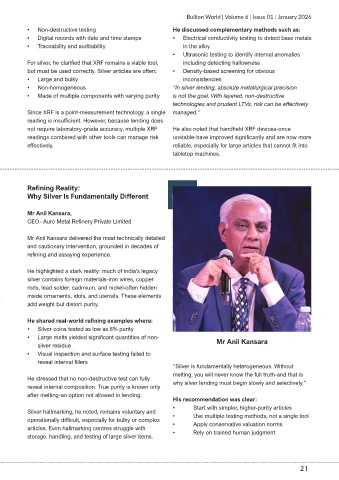
           Mr Anil Kansara,
           CEO- Auro Metal Refinery Private Limited


           Mr Anil Kansara delivered the most technically detailed
           and cautionary intervention, grounded in decades of
           refining and assaying experience.


           He highlighted a stark reality: much of India’s legacy
           silver contains foreign materials-iron wires, copper
           rods, lead solder, cadmium, and nickel-often hidden
           inside ornaments, idols, and utensils. These elements
           add weight but distort purity.


           He shared real-world refining examples where:
           •   Silver coins tested as low as 8% purity
           •   Large melts yielded significant quantities of non-
              silver residue                                                 Mr Anil Kansara
           •   Visual inspection and surface testing failed to
              reveal internal fillers
                                                              “Silver is fundamentally heterogeneous. Without
                                                              melting, you will never know the full truth-and that is
           He stressed that no non-destructive test can fully
                                                              why silver lending must begin slowly and selectively.”
           reveal internal composition. True purity is known only
           after melting-an option not allowed in lending.
                                                              His recommendation was clear:
                                                              •      Start with simpler, higher-purity articles
           Silver hallmarking, he noted, remains voluntary and
                                                              •      Use multiple testing methods, not a single tool
           operationally difficult, especially for bulky or complex   •   Apply conservative valuation norms
           articles. Even hallmarking centres struggle with
                                                              •      Rely on trained human judgment
           storage, handling, and testing of large silver items.


                                                                                                          21

