China money rattles gold market in volatile week
Thu Feb 05 2026
Recent swings in gold prices have been amplified by China, where retail investors have bought the precious metal on the dip following a sell-off by institutional investors. Gold plummeted last week after the nomination of Kevin Warsh as the next chair of the U.S. Federal Reserve. Warsh's past stance as an inflation hawk was seen by some as a sign he would be less open to the deep interest rate cuts that U.S. President Donald Trump has urged.
The dollar rebounded, and then came a sharp drop in the price of gold in Asian markets. Another factor in the sell-off was that commodity trading adviser models at Chinese quantitative hedge funds had already begun drawing down gold holdings ahead of the Lunar New Year holiday, Bloomberg reported, adding that the sudden reversal in gold prices triggered heavy losses for leveraged investors, from investment funds to ordinary housewives.
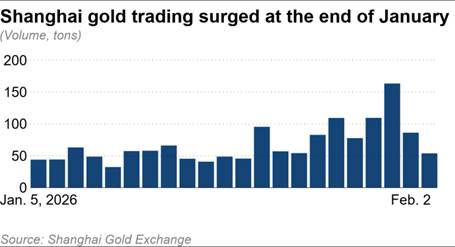
Some had been warning that the gold market was overheated by an influx of money from Chinese retail investors and speculators. When the price of gold fell, speculative investors in mainland China pulled back, fueling market fears that liquidity was drying up. Trading volume on the Shanghai Gold Exchange surged when gold prices tumbled. Fear of missing out had been a a driving force behind gold's rise, and now the slump presented a long-awaited opportunity for those looking to buy on the cheap.
At a shopping center in Shanghai, many customers on Tuesday browsed gold bracelets and rings in the wake of the plunge. "It suddenly became crowded with customers wanting to buy while prices are still low," said a sales associate. With the Lunar New Year approaching, some were also buying gold as holiday gifts.
At a shopping mall in Wuhan, Hubei province, customers lined up for a sale on gold products. They wore bathrobes and sat in folding chairs, waiting all night for the store to open, local media reported. The stock price of Laopu, dubbed China's Hermes of gold, has soared to about 20 times its initial public offering price.
"Products from Laopu Gold can be resold for more than the gold itself," said a woman living in Hubei. Chinese retail sales of gold, silver, and jewelry reached a record high of 373.6 billion yuan ($53.8 billion) in 2025, according to China's National Bureau of Statistics, up 13% from a year earlier. That brought the total since 2006 to 4.6 trillion yuan. The figures include purchases of gold brought in from outside the mainland, such as from Hong Kong, and gold bought through exchange-traded funds.
Gold is seen as one of the few investment options that have not betrayed Chinese retail investors. Restrictions have been imposed on converting the yuan into foreign currencies or taking it overseas, leaving Chinese investors with few options for shielding their assets. The Shanghai Composite Index is on an upward trend, but the benchmark is still more than 30% below its 2007 peak. "It's a dip, buy the dip," said a post by a well-known blogger that has been echoed on Chinese social media. The blogger claims to have bought gold on 12 occasions during the current downturn.
Opinion on Chinese social media was divided, with some questioning whether there was even a correct valuation for gold. Chinese authorities are on alert. Postal Savings Bank of China issued a notice on Monday urging investors to avoid chasing high prices and cutting losses, and to control their investment amounts. China Construction Bank has raised its minimum purchase amount, while Industrial and Commercial Bank of China will take steps to limit holiday trading amounts from Saturday.
When the People's Bank of China, the country's central bank, decided to resume building up gold reserves, Chinese retail investors saw the move as a signal to buy gold. Now authorities are issuing warnings that could tamp down one of the biggest sources of demand for the precious metal.
Source: https://asia.nikkei.com/