World Gold Council: Gold demand near record levels, central banks buy 321 tonnes, ETFs boom
Thu Nov 05 2026
The global gold market saw a notable trend in the first nine months of 2026: While high prices dampened demand for jewelry and gold bars, central banks and gold ETFs continued to buy large quantities of the precious metal.
According to the latest Gold Demand Trends report from the World Gold Council, global gold demand reached around 1,369 tonnes in the third quarter of 2026. This was just one percent below the year-earlier level. Particularly notable were substantial central bank purchases of 321 tonnes and the return of institutional investors to gold-backed ETFs. At the same time, supply is declining slightly despite record mine production.
In the first nine months of the year, global gold demand, including over-the-counter transactions, totaled 3,881 tonnes. This nearly matched the previous year's record of 3,884 tonnes. The value of demand over this period reached a new high of US$566 billion.
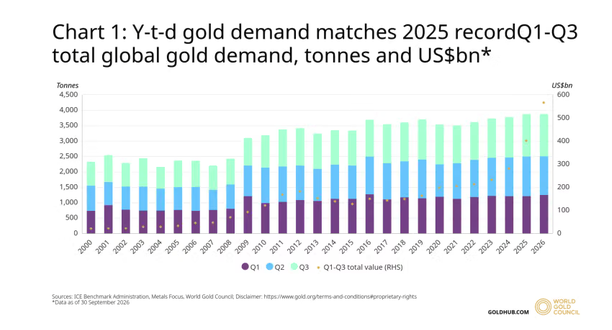
The average gold price in the third quarter was 4,262 US dollars per troy ounce, 23 percent above the year-earlier level.
Gold demand: Central banks and gold ETFs remain key buyers
Central banks recorded the strongest growth. Their net purchases rose to 321 tonnes in the third quarter, up 42 percent from the same period a year earlier. This also put them well above the quarterly average of 227 tonnes over the past five years. Year-to-date official gold purchases total 675 tonnes, six percent more than in the corresponding period of 2025.
China and Poland were particularly active. The Chinese central bank increased its reserves by 63 tonnes in the third quarter, while Poland purchased another 40 tonnes. Together, the two countries accounted for around 86 percent of officially reported net purchases.
However, the gap between reported transactions and estimated total demand is notable. While reported net purchases totaled only 120 tonnes, the World Gold Council estimates actual demand at 321 tonnes. This implies that around 63 percent of activity was not directly disclosed at the country level.
In addition to central banks, gold ETFs generated additional demand. After outflows in the second quarter, physically backed funds recorded inflows of 211 tonnes between July and September. This brought their global gold holdings to a record 4,256 tonnes. The quarter was also exceptional in financial terms: investors put a net total of around US$31 billion into gold ETFs—a new record.
Europe led the trend with 92 metric tons, including 53 metric tons in the UK and 13 metric tons in Germany. North American funds recorded inflows of 81 metric tons, while Asian ETFs added another 34 metric tons. According to the World Gold Council, concerns about the long-term sustainability of public finances, inflation risks and uncertainty in bond markets were key factors supporting gold's appeal.
Gold bars and jewelry lose ground – China sets its own trend
Private buyers of gold bars and coins, by contrast, were considerably more cautious. Global demand fell by 19 percent to 268 metric tons in the third quarter, reaching its lowest quarterly level in four years. Nevertheless, the longer-term trend remains strong: Demand totaled 1,053 metric tons from January through September, the highest volume for this period since 2013.
There were significant regional differences. In China, demand for bars and coins rose seven percent year over year to 79 tonnes. Year-to-date purchases there reached a new record of 393 tonnes.
India, by contrast, recorded a decline of 40 percent to 55 metric tons. In Germany, demand fell by 20 percent to 7.8 metric tons, while US investors also reduced their purchases by 40 percent to around eight metric tons.
High prices are weighing even more heavily on the jewelry market. Global gold jewelry consumption fell by 17 percent to 313 metric tons. It was the weakest third quarter since the data series began in 2000. The decline was particularly pronounced in China at 22 percent and India at 20 percent.
Despite declining sales volumes, the global value of demand for gold jewelry rose by 2 percent to $43 billion. Consumers are increasingly opting for lighter pieces of jewelry and products with a lower gold content.
Industrial applications showed the opposite trend. Gold consumption in the technology sector rose by three percent to just under 85 metric tons. The electronics industry alone used 72.5 metric tons, five percent more than in the previous year.
Investments in artificial intelligence, data centers and high-performance semiconductors are a key driver of growth. They offset reductions in usage and the increasing use of alternative materials in other electronics applications.
Gold production at record levels – yet recycling supply declines
On the supply side, global gold mine production reached a record 1,071 metric tons in the third quarter. This represents an increase of three percent year over year. Production rose particularly sharply in Canada, up 22 percent, Indonesia, up 21 percent, and Chile, up 19 percent. By contrast, production declined in Australia and the US, among other countries.
Despite record production, total gold supply fell by one percent to 1,369 metric tons. Recycling was the main driver: the amount of gold recovered fell by eight percent to around 314 metric tons, its lowest quarterly level since the end of 2023.
Higher production costs are also weighing on the mining sector. Average all-in sustaining costs (AISC) at gold mines reached a record $1,930 per ounce in the second quarter of 2026, an increase of 22 percent year over year.
Nevertheless, the World Gold Council expects record mine production for the full year. However, the additional mine supply is likely to be largely offset by weak recycling.
On the demand side, the organization expects central banks to buy at least as much gold as in 2025. Investment demand is expected to exceed the previous year's level by around 200 tonnes.
The opposing macroeconomic forces remain key: Higher interest rates, bond yields and a stronger dollar could weigh on gold. Fiscal uncertainty, geopolitical risks and potential financial market strains, on the other hand, are likely to continue supporting demand.
The gold market thus remains shaped by a fundamental contrast: While high prices increasingly deter traditional buyers, central banks and financial investors sustain a substantial share of global demand.
Data Source Statement: Except for publicly available information, all other data are processed by SMM based on publicly available information, market communication, and relying on SMM's internal database model. They are for reference only and do not constitute decision-making recommendations.
Source: https://news.metal.com/